
The end of the US-led world order
The dominant theme in the media at present is the end of the world order that has prevailed since the Second World War. Until now, the USA has provided public goods such as open sea lanes, the dollar-based financial system, a security architecture, and rules for dispute resolution. With the abandonment of multilateralism in favour of “America First”, this has changed. The USA is withdrawing as a global power. This article examines what this could mean for assets.
The law of the strongest
The World Economic Forum in Davos in January 2026 could go down in history as an official turning point. Even though the US President refrained from a military takeover of Greenland and did not introduce the threatened tariffs for some European countries, it should be clear by now at the latest that the post-war order shaped by the United States can only be viewed in the rear-view mirror. In a widely acclaimed speech, Canadian Prime Minister Mark Carney spoke of the end of the previous rules-based, quasi-universal order and the “harsh reality of superpower rivalry”.
“The post-war order shaped by the USA can now only be viewed in the rear-view mirror.”
Gerhard Winzer, Chief Economist with Erste Asset Management
(c) Stefan Huger
Model rivalry: from territorial power to network dominance
The models of the powerful countries differ in this respect. Russia offers the classic military-territorial empire. This is not particularly attractive to other countries (see Ukraine). At the other end of the spectrum is the European Union. Here, regulatory goods (norms and standards) are being produced and exported. Mark Carney also addressed this level. The role of middle powers such as Canada could be to build a new international order based on human rights, sovereignty, territorial integrity, sustainability, and solidarity. We should like to point out that only here do ESG standards matter. The European Union is working on this – sometimes with setbacks, even though time is pressing.
While the trade agreement between the EU and the Mercosur countries has been signed, the European Parliament is having the European Court of Justice examine whether the agreement is compatible with EU law. On a positive note, the EU and India have concluded a far-reaching trade agreement to facilitate trade for around two billion people. The agreement aims to reduce tariffs on European cars and wines and to simplify access for Indian textiles and electronics to the EU. China's model can be called geo-economic. The aim here is to achieve or expand dominance in the manufacturing sector, including supply chains and certain raw materials (rare earths). The US model, on the other hand, can be described as network-based. This applies to several important areas, such as finance, technology, and security. Here, we can see how dependent Europe in particular is on the United States.
Tariffs, leverage, and new mechanisms of exclusion
The rivalry between different models of governance means that global public goods are losing importance and so-called club goods are on the rise. Goods (such as free trade) that were once open are becoming bloc-bound, restricted in access, and politically conditioned. The US President's favourite word is actually “tariffs”: these are intended not only to close the US trade deficit, build up the US manufacturing sector, and restructure the budget, but also to exert pressure on trading partners.
Most recently, the US President threatened Canada with punitive tariffs of 100% if Ottawa concludes a planned trade agreement or engages in a more involved trade relationship with China. Threats were also made in South Korea’s general direction: the US President announced that he would drastically increase tariffs on imports from South Korea because the trade agreement between the two countries had not yet been implemented. Overall, international trade is increasingly being hampered by export controls, tariffs, investment restrictions, and sanctions. Accepting the possible end of the transatlantic defence alliance if some NATO members do not “behave well” is also part of the new US order.
Uncertainty reduces predictability
The possible consequences are: states arguing and acting in a revisionist fashion (“this territory actually belongs to us”), less predictable dispute resolution, a higher probability that trade, finance, and technology will become leverage for political goals, higher transaction costs, and more investment in defence, infrastructure, and proprietary technologies. It is also sometimes argued that increased uncertainty reduces predictability and could thus dampen investment appetite.
Risk reduction und diversification
Based on this, governments and companies have consulted the portfolio management textbook: in order to reduce dependencies and build strategic autonomy in certain segments, the political buzzword of the moment is risk reduction (derisking). Governments and companies are diversifying supply chains (reducing dependence on China) and building redundant capacities for energy, commodities (rare earths), semiconductors, batteries, pharmaceuticals, cloud computing, and defence.
US dollar depreciates, gold gains
Diversification also applies to the financial sector. The US dollar dominates payment transactions, asset pricing (with the Fed as the central bank for the global financial sector) and foreign currency reserves. But its uniqueness is crumbling. The US dollar's share of foreign currency reserves is falling slightly but steadily. More and more commodity contracts are not denominated in US dollars, and parallel payment systems to SWIFT have developed (CIPS – China's global interbank payment system). In a system of geopolitical rivalry, the dominant status of the US dollar as a foreign reserve currency could indeed be affected.
The key question is: does the reserve currency function in times of stress? This includes, for example, stabilising exchange rates, absorbing external shocks, meeting payment obligations (interest payments on government debt), paying for commodity imports, and so on. If it is conceivable that access to US dollar reserves could be restricted in the event of a conflict with the United States (for example, for non-club members), then central banks will probably diversify their reserves more broadly (more gold, possibly more euros and renminbi). In fact, the price of gold has continued to rise sharply against the US dollar this year (to over USD 5,000 per troy ounce). Or, really: the dollar has continued to lose significant value against gold.
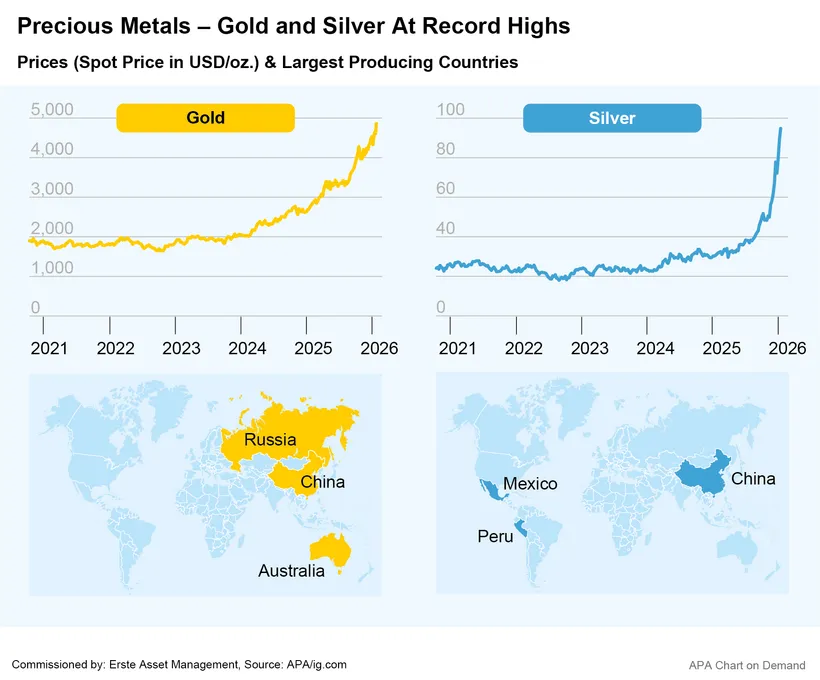
As of 21/01/2026
Country risk as new evaluation factor
How is the narrative of rivalry between forms of governance transferred to asset pricing? Through the country risk channel. Generally speaking, the higher the country risk, the lower the price of the asset, because the discount rate is higher. This means that future profits are worth less today. The division of the world into spheres of influence could blur the previous distinction between developed economies and emerging markets. Until now, gross domestic product per capita has been the most important criterion for a quick assessment of country risk. Now, the risk of being cut off from access to technology (US IT companies), security (NATO), finance (US capital market), and trade (US consumer market) have also become factors.
For example, the end of NATO would significantly increase the country risk of European countries.
In the Eurozone, external pressure increases the likelihood of the mutualisation of sovereign debt. This reduces country risk. China's high trade surplus implies the risk of a strengthening of the Chinese currency. This would probably mean a structural appreciation of the entire Asian region. Overall, country risk should be factored more actively than before into the valuation of assets – even in developed economies.
Consequences for the portfolio allocation: more Europe and Asia?
In the construction of portfolios, greater emphasis should be placed on risk. The question could be: how resilient is the portfolio to a change in the regulatory system?
Consideration should be given to whether the dimension of “regulatory structure” (USA, EU, China, Russia) should be added to the allocation by asset class, sector, factor, and country. Networks, technology dependencies, capital flows, military bases, energy routes, and the desire to control systems will play a greater role in the future. This would probably imply a lower US share in a portfolio in favour of Europe and Asia.
Conclusion
Both economies and financial markets have so far been surprisingly resilient to the change in the geopolitical order. Global economic growth is on trend, earnings growth is high, and inflation is only slightly elevated. The monetary policies in place are supportive (high liquidity), and the fiscal policies are also loose. The increase in US tariffs and generally greater uncertainty have not been strong enough to tip the system. However, as it is unclear whether a structural break in the form of a sharp increase in country risk could occur in the future, greater emphasis should be placed on resilience to changes in the order structure when allocating portfolios.
For explanations of technical terms, please visit our Fund Glossary.
Disclaimer
This document is an advertisement. Please refer to the prospectus of the UCITS or to the Information for Investors pursuant to Art 21 AIFMG of the alternative investment fund and the Key Information Document before making any final investment decisions. Unless indicated otherwise, source: Erste Asset Management GmbH. Our languages of communication are German and English.
The prospectus for UCITS (including any amendments) is published in accordance with the provisions of the InvFG 2011 in the currently amended version. Information for Investors pursuant to Art 21 AIFMG is prepared for the alternative investment funds (AIF) administered by Erste Asset Management GmbH pursuant to the provisions of the AIFMG in connection with the InvFG 2011. The fund prospectus, Information for Investors pursuant to Art 21 AIFMG, and the Key Information Document can be viewed in their latest versions at the web site www.erste-am.com within the section mandatory publications or obtained in their latest versions free of charge from the domicile of the management company and the domicile of the custodian bank. The exact date of the most recent publication of the fund prospectus, the languages in which the fund prospectus or the Information for Investors pursuant to Art 21 AIFMG and the Key Information Document are available, and any additional locations where the documents can be obtained can be viewed on the web site www.erste-am.com. A summary of investor rights is available in German and English on the website www.erste-am.com/investor-rights as well as at the domicile of the management company.
The management company can decide to revoke the arrangements it has made for the distribution of unit certificates abroad, taking into account the regulatory requirements.
Detailed information on the risks potentially associated with the investment can be found in the fund prospectus or Information for investors pursuant to Art 21 AIFMG of the respective fund. If the fund currency is a currency other than the investor's home currency, changes in the corresponding exchange rate may have a positive or negative impact on the value of his investment and the amount of the costs incurred in the fund - converted into his home currency.
Our analyses and conclusions are general in nature and do not take into account the individual needs of our investors in terms of earnings, taxation, and risk appetite. Past performance is not a reliable indicator of the future performance of a fund.